



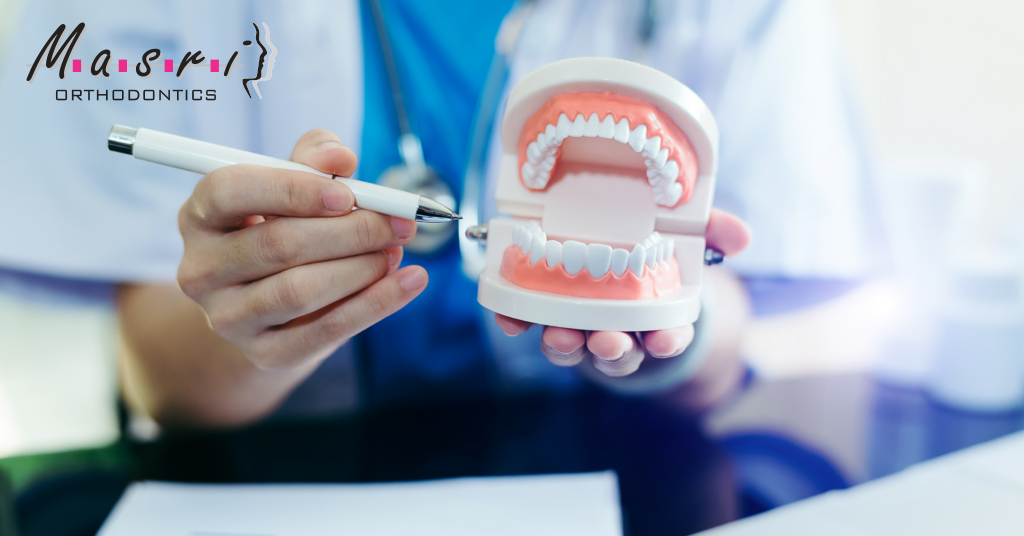
If you are missing a tooth and plan to replace it, orthodontic treatment often comes first. Braces or aligners can open the right amount of space for an implant or bridge, or close the gap entirely, so the replacement fits a bite that works.
It is a question we hear often from adults whose dentist has mentioned an implant, and from parents whose child is missing a permanent tooth that never came in. Here is how the two kinds of care fit together and what the order of operations usually looks like.
What Happens to Your Teeth When a Tooth Is Missing?
Teeth are held in place partly by their neighbors. Take one away and the mouth slowly rearranges itself around the gap.
Neighboring teeth drift and tip
The teeth on either side of a gap tend to lean into it. Over time the space can shrink, or become the wrong shape, so an implant no longer fits without crowding the teeth beside it.
The opposing tooth can move too
A tooth that has lost its partner in the opposite jaw has nothing to bite against, and it can slowly move toward the gap. That changes how the whole bite meets.
Why this matters for a replacement
A crown on an implant or a bridge is made to fit the space and the bite as they are when it is placed. If the space is too small, tilted, or out of line with the opposing teeth, the replacement inherits those problems.
Why Do Braces Often Come Before an Implant or Bridge?
Our page on common orthodontic problems puts it plainly: by moving all of the teeth into their correct positions, the right space can be created for replacing missing teeth.
Implants cannot be moved once placed
An implant is fused to the bone. Unlike a natural tooth, it will not move with braces. Placing it first means the rest of the teeth have to be arranged around it, which limits what treatment can achieve. As our braces for adults page explains, an existing implant becomes a fixed point the plan has to work around.
A bridge depends on the teeth beside it
A bridge is anchored to the neighboring teeth. If those teeth are tipped or rotated, it is harder to build a bridge that fits well and is easy to clean. Straightening them first gives the restoration a better foundation.
The bite comes first, the crown second
When restorative work waits until after alignment, the final crown or bridge is built into the corrected bite rather than the old one. That is the same reason many adults hold off on new crowns until orthodontic treatment is finished.
Should the Gap Be Opened or Closed?
Not every missing tooth needs replacing. Sometimes the better plan is to move the other teeth so the space disappears.
When opening space makes sense
If closing the gap would throw off the bite, the facial profile or how the front teeth look together, the usual plan is to create a properly sized space and replace the tooth.
When closing space makes sense
In some mouths the neighboring teeth can be moved in to fill the gap so no replacement is needed. Temporary anchorage devices (TADs) have made this far more practical. As our TAD page notes, they can close spaces where teeth are missing and avoid the need for tooth replacement.
What decides it
- How the back teeth meet, and whether closing the gap would disturb that
- How the smile looks, including the shape and color of the tooth that would take the missing tooth’s place
- The health of the gums and bone where a replacement would go, which your dentist assesses
- Your own preferences: a replacement tooth needs its own care for life, while a closed space does not
There is rarely one right answer for everyone, which is why this decision is made with full records and, when a replacement is on the table, together with your dentist.
| Option | What orthodontics does | What comes after | Worth considering when |
|---|---|---|---|
| Open space for an implant | Creates a gap of the right size, with roots angled out of the way | Implant and crown placed by your dentist or surgeon | Closing the gap would compromise the bite or smile |
| Open space for a bridge | Straightens and positions the teeth that will support the bridge | Bridge made by your dentist | An implant is not the right fit for you |
| Close the space | Moves neighboring teeth into the gap, often with TADs | Usually no replacement needed | The bite and appearance work without the missing tooth |
| Hold the space | Keeps the gap from shrinking after treatment | Replacement placed later, when the timing is right | A replacement has to wait, for example during growth |
What About Teenagers Missing a Permanent Tooth?
Some teens have a permanent tooth that never formed, often one of the upper side front teeth. The baby tooth may hang on for years or fall out with nothing behind it.
Planning around growth
An implant is generally placed once the jaw has finished growing, which can be years after braces come off. In the meantime the space has to be kept the right size so it is ready when the time comes.
Holding the space
After braces, a retainer keeps the teeth from drifting back into the gap. A temporary tooth can often be attached to the retainer so the smile looks complete while the patient waits.
Or closing it instead
For some teens, closing the space and reshaping the neighboring teeth is the better long-term answer. The decision depends on the bite, the face and the shape of the surrounding teeth, which is why it is worth making it early.
How Do Your Orthodontist and Dentist Work Together?
One plan, two offices
Treatment works best when your orthodontist and dentist agree on the plan before anything moves. At the first visit we ask what work you have already had done and what your dentist is planning next, so the space we create matches the replacement they intend to place. The orthodontist sets up the teeth; the dentist or surgeon places and restores the replacement.
The usual order of events
- Records and a shared plan: which teeth to move and how much space to create
- Orthodontic treatment to open, close or reposition the space
- A check that the space and root positions are right for the replacement
- Implant or bridge placed by your dentist or surgeon
- Retainers to keep everything where it belongs
Braces or aligners?
Both can be used to prepare a space. Our guide to types of braces compares the fixed options, and Invisalign in Livonia covers the clear aligner route, which many adults prefer for a discreet course of treatment.
Frequently Asked Questions About Braces and Missing Teeth
Can I get braces if I already have an implant?
Yes. The implant stays where it is, and the plan is designed around it as a fixed point. In some cases it can even help as an anchor for moving other teeth.
Can I get braces with a bridge?
Often, yes, though a bridge joins teeth together so they cannot move independently. Sometimes the bridge is replaced after treatment so the new one fits the corrected bite.
Should I get the implant first to save time?
Usually not. Placing the implant first can lock in a gap that is the wrong size or position, and it cannot be adjusted later. Ask your dentist and orthodontist to agree on the order before anything is placed.
How long do I wait between braces and an implant?
For adults the replacement can often follow soon after the space is ready. For teens it may be a matter of years, until growth is complete, with a retainer holding the space in the meantime.
Plan Your Treatment With Masri Orthodontics
If your dentist has mentioned an implant or bridge, it is worth seeing an orthodontist before anything is placed. Dr. Nawaf Masri has treated adults and teens across Southeast Michigan for more than 26 years. Request a complimentary consultation or call (734) 261-8860.